Here you can watch lectures from the 2016 Deep Learning Summer School in Montreal.
Course excerpt:
Deep neural networks that learn to represent data in multiple layers of increasing abstraction have dramatically improved the state-of-the-art for speech recognition, object recognition, object detection, predicting the activity of drug molecules, and many other tasks. Deep learning discovers intricate structure in large datasets by building distributed representations, either via supervised, unsupervised or reinforcement learning.
The Deep Learning Summer School 2016 is aimed at graduate students and industrial engineers and researchers who already have some basic knowledge of machine learning (and possibly but not necessarily of deep learning) and wish to learn more about this rapidly growing field of research.
Here is the schedule in which you could view the presentations
table.schedule td {
vertical-align: top;
padding: 10px;
}
| 01/08/2016 |
02/08/2016 |
03/08/2016 |
04/08/2016 |
05/08/2016 |
06/08/2016 |
07/08/2016 |
9:00
10:30 |
Doina
Precup
|
Rob
Fergus
|
Yoshua
Bengio
|
Kyunghyun
Cho
|
Joelle
Pineau
|
Ruslan
Salakhutdinov
|
Bruno
Olshausen
Neuro I
|
10:30
11:00 |
Coffee
Break |
Coffee
Break |
Coffee
Break |
Coffee
Break |
Coffee
Break |
Coffee
Break |
Coffee
Break |
11:00
12:30 |
Hugo Larochelle
|
Antonio Torralba
|
Sumit
Chopra
|
Edward Grefenstette
|
Pieter
Abbeel
|
Shakir
Mohamed
|
Surya
Ganguli
and Deep Learning Theory
|
12:30
14:30 |
Lunch |
Lunch |
LunchWiDL event |
Lunch |
Lunch |
Lunch |
Lunch |
14:30
16:00 |
Hugo Larochelle
Neural Networks II (click on part II) |
Alex Wiltschko
Torch I |
Jeff
Dean
& TensorFlow |
Julie Bernauer
(NVIDIA)
GPU programming with CUDA |
Joelle, Pieter & Doina
Advanced Topics in RL |
Contributed
talks
Session 4 |
Contributed
talks
Session 4 |
16:00
16:30 |
Coffee
Break |
Coffee
Break |
Coffee
Break |
Coffee
Break |
Coffee
Break |
Coffee
Break |
Coffee
Break |
16:30
18:00 |
Pascal
Lamblin
|
Practical
Session
Alex Wiltschko
(Torch)
Frédéric Bastien
(Theano) |
Jeff
Dean
|
Contributed
talks
Session 1 |
Contributed
talks
Session 2 |
Contributed
Posters
Session 1 |
Contributed
Posters
Session 2 |
| Evening |
Opening Reception
(18:00-20:30)
— by —
Imagia |
Happy Hour
(18:45-22:30)
buses at 18:30
— by —
Maluuba |
Happy Hour
(18:30-20:30)
— by —
Creative Destruction Lab |
(or you can just follow them in consecutive order at http://videolectures.net/deeplearning2016_montreal/ since they seem to be in the order they were presented.)
Contributed talks:
12:55 Chains of Reasoning over Entities, Relations, and Text using Recurrent Neural Networks
Rajarshi Das
14:29 Professor Forcing: A New Algorithm for Training Recurrent Networks
Anirudh Goyal
10:59 Zoneout: Regularizing RNNs by Randomly Preserving Hidden Activations
Tegan Maharaj
18:58 Deep multi-view representation learning of brain responses to natural stimuli
Leila Wehbe
14:49 Learning to Communicate with Deep Multi-Agent Reinforcement Learning
Jakob Foerster
13:57 Model-Based Relative Entropy Stochastic Search
Abbas Abdolmaleki
16:33 Learning Nash Equilibrium for General-Sum Markov Games from Batch Dat
Julien Pérolat
20:30 A Network-based End-to-End Trainable Task-oriented Dialogue System
Tsung-Hsien Wen
15:28 Inference Learning
Patrick Putzky
16:45 Variational Autoencoders with PixelCNN Decoders
Ishaan Gulrajani
13:33 An Infinite Restricted Boltzmann Machine
Marc-Alexandre Côté
15:15 Deep siamese neural network for prediction of long-range interactions in chromatin
Davide Chicco
14:09 Beam Search Message Passing in Bidirectional RNNs: Applications to Fill-in-the-Blank Image Captioning
Qing Sun
18:40 Analyzing the Behavior of Deep Visual Question Answering Models
Aishwarya Agrawal
13:55 Recombinator Networks: Learning Coarse-to-Fine Feature Aggregation
Sina Honari

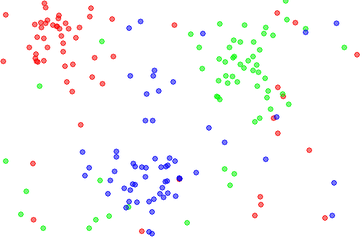 The Dataset
 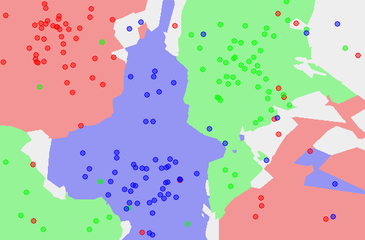 The 5NN classification map